Most fitness advice was historically built on research in men and then simply applied to everyone. But the female body has different hormones, different body fat norms, its own monthly rhythm and its own risks. Ignore those differences and it’s easy to get discouraged by a “jumpy” scale, steer clear of the barbell or push yourself into a far-too-harsh routine. In this article you’ll learn what counts as normal body composition for women, how your cycle affects your measurements, why strength training won’t make you bulky and which signals deserve your attention.
How much body fat is normal?
Women carry more essential fat — the fat needed for hormonal and reproductive function, nerve tissue and bone marrow. Under the American Council on Exercise (ACE) classification, that’s roughly 10–13% of body weight in women versus 2–5% in men. Dropping toward those numbers is risky for your health.
Approximate body fat ranges according to ACE:
| Category | Women | Men |
|---|---|---|
| Essential fat | 10–13% | 2–5% |
| Athletes | 14–20% | 6–13% |
| Fitness | 21–24% | 14–17% |
| Average | 25–31% | 18–24% |
| Above average | 32% and up | 25% and up |
The key takeaway: 25% body fat in a woman isn’t “too much” — by ACE classification it’s a normal average. Comparing yourself with men’s numbers or with photos of athletes at competition leanness makes no sense; that level of leanness can only be held briefly, and rarely without side effects.
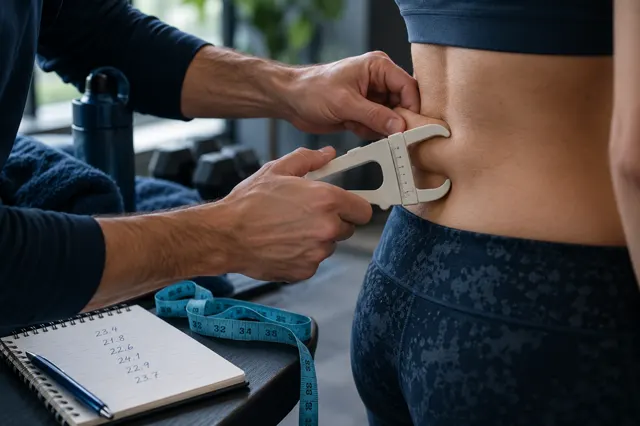
Fat distribution differs, too. Before menopause, women tend to store fat around the hips and glutes. That’s why the women’s version of the U.S. Navy formula uses hip circumference in addition to waist and neck. You can read how the calculation works in the article on measuring body fat without devices.
Your menstrual cycle and weight swings
Estrogen and progesterone levels shift across the cycle, and so does water retention. A typical pattern:
- right after your period (early and mid follicular phase), weight and measurements are usually at their lowest;
- in the second half of the cycle (luteal phase), and especially in the last days before your period, your body holds on to water — weight can rise 1–2 kg and your waist a couple of centimeters; according to White and colleagues (2011), fluid retention peaks on average on the first day of menstruation and is lowest in the mid-follicular phase;
- appetite may increase and workouts may feel harder in those days — dramatically for some women, barely at all for others.
That isn’t fat, and it isn’t a failed diet. But compare a measurement taken after your period with one taken just before it, and you can easily draw the wrong conclusion.
How to measure consistently
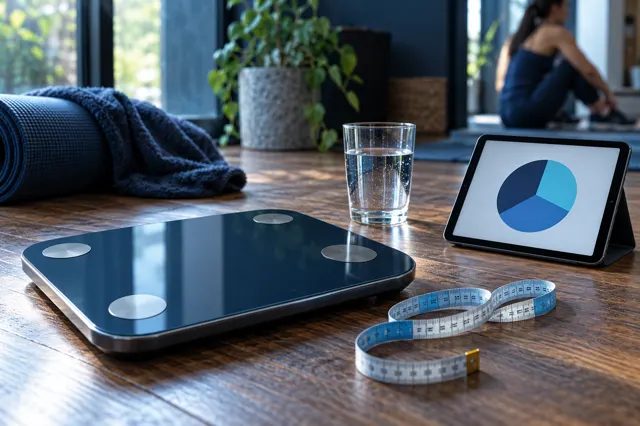
- Weigh yourself in the morning, after using the bathroom, before eating or drinking, under the same conditions every time.
- Compare measurements and body fat in the same cycle phase — for example, once a month during the first week after your period ends.
- Between those reference measurements, look at your weekly average weight rather than individual readings.
- Note your cycle day next to each measurement so any jumps make sense right away.
- With hormonal contraception, swings are often smaller, but the same-conditions rule still applies.
Strength training won’t make you bulky
The fear of getting “too muscular” from lifting is one of the most persistent myths. Women’s testosterone levels are many times lower than men’s, so absolute muscle gain is considerably smaller. Yet in a meta-analysis by Roberts and colleagues (2020), relative gains in muscle size and lower-body strength were comparable between women and men, and women’s relative upper-body strength gains were even larger. So you can train by the same principles.
What strength training actually gives you:
- a firmer, more defined body, because muscle takes up less space than the same mass of fat;
- higher bone mineral density, which becomes more important with age;
- better insulin sensitivity and a steadier weight while dieting.
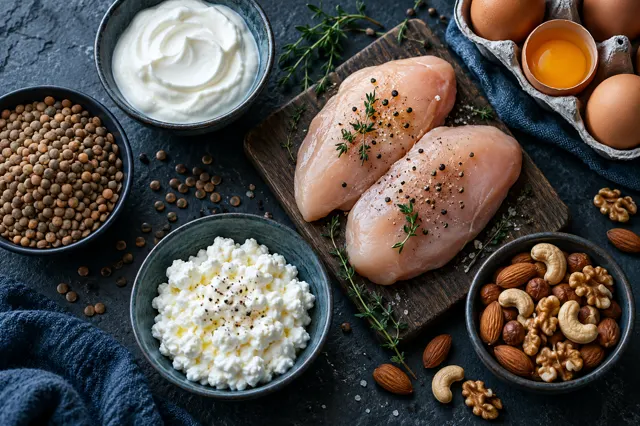
If you feel like you’ve gotten “bigger,” it’s usually because the muscle under the same layer of fat has gotten stronger. Your measurements and body fat percentage tell the real story — not the mirror. The core principle of growth is gradually increasing the load — there’s a separate article on progressive overload. Your protein needs are the same as men’s, 1.4–2.0 g/kg; the details are in the article on protein for muscle gain.
RED-S: when energy runs too low
The International Olympic Committee describes Relative Energy Deficiency in Sport (RED-S) — abbreviated REDs since 2023 — in its consensus statements from 2014, 2018 and 2023. It develops when energy from food consistently falls short of what training and basic body functions require. It isn’t limited to elite athletes: women who pair a strict diet with frequent workouts are at risk, too.
Warning signs:
- missing, infrequent or irregular periods — this is not normal for women who train;
- stress fractures, frequent injuries, slow recovery;
- persistent fatigue, frequent colds, declining performance;
- constant thoughts about food and weight.
If this sounds familiar, see your gynecologist or a sports medicine doctor. And reconsider your deficit — a sensible pace is laid out in the article on a calorie deficit without the extremes.
Iron
Because of monthly blood loss, women of reproductive age need more iron than men: the German Nutrition Society (DGE, 2023) recommends 16 mg a day for premenopausal women and 11 mg for men, while the U.S. National Institutes of Health (NIH) recommend 18 mg and 8 mg, respectively. Iron deficiency is one of the most common causes of fatigue, breathlessness and declining endurance.
- Include iron sources such as red meat, liver, legumes, tofu and dark leafy greens.
- Plant iron is absorbed less efficiently; vitamin C in the same meal helps, while coffee and tea right after eating get in the way.
- Don’t take iron “just in case”: if you feel tired, get blood work first, including ferritin, and review it with your doctor.
Menopause
As estrogen declines, body composition changes. Fat is more likely to settle around the abdomen, including visceral fat, and muscle mass and bone density are lost faster. Meanwhile, weight may barely change — which makes the scale alone especially uninformative.
What helps:
- strength training 2–3 times a week — the most important tool for muscle and bone;
- enough protein, toward the upper half of the range;
- regular waist circumference checks;
- a conversation with your doctor about calcium, vitamin D and options for managing symptoms.
Pregnancy
During pregnancy and after giving birth, body fat formulas don’t apply: measurements and weight change for entirely different reasons. The WHO recommends moderate activity during pregnancy when there are no contraindications, but please work out your specific training and nutrition plan with your doctor.
Checklist for accurate tracking
- Measure body fat with the women’s formula, including hip circumference.
- Compare measurements taken in the same cycle phase.
- Judge the trend over 2–3 months, not a single reading.
- Treat a regular cycle as a health marker worth watching.
In FitHilf you can log your weight and 11 body measurements, including waist and hips, get your body fat percentage from the sex-specific U.S. Navy formula, see your fat mass and muscle mass, and chart any time period. Try it in the dashboard — and to put the numbers in context, read why body composition matters more than weight.
Sources
- American Council on Exercise (ACE). Body fat percentage: charting averages in men and women. acefitness.org
- White CP, Hitchcock CL, Vigna YM, Prior JC (2011). Fluid retention over the menstrual cycle: 1-year data from the prospective ovulation cohort. Obstetrics and Gynecology International, 2011, 138451. doi:10.1155/2011/138451
- Roberts BM, Nuckols G, Krieger JW (2020). Sex differences in resistance training: A systematic review and meta-analysis. Journal of Strength and Conditioning Research, 34(5), 1448–1460. doi:10.1519/JSC.0000000000003521
- Mountjoy M, Sundgot-Borgen JK, Burke LM, et al. (2018). IOC consensus statement on relative energy deficiency in sport (RED-S): 2018 update. British Journal of Sports Medicine, 52(11), 687–697. doi:10.1136/bjsports-2018-099193
- Mountjoy M, Ackerman KE, Bailey DM, et al. (2023). 2023 International Olympic Committee's (IOC) consensus statement on Relative Energy Deficiency in Sport (REDs). British Journal of Sports Medicine, 57(17), 1073–1098. doi:10.1136/bjsports-2023-106994
- Deutsche Gesellschaft für Ernährung (DGE) (2023). Referenzwerte für die Nährstoffzufuhr: Eisen. dge.de
- NIH Office of Dietary Supplements. Iron: Fact Sheet for Health Professionals. ods.od.nih.gov
- Bull FC, Al-Ansari SS, Biddle S, et al. (2020). World Health Organization 2020 guidelines on physical activity and sedentary behaviour. British Journal of Sports Medicine, 54(24), 1451–1462. doi:10.1136/bjsports-2020-102955
FAQ
What body fat percentage is healthy for women?
By ACE classification, the average range is 25–31%, and good fitness is 21–24%. Going near essential fat levels (10–13%) is risky.
Why do I weigh a kilo more before my period?
In the second half of the cycle, hormones make your body retain water. It’s a temporary fluctuation, not fat; weight usually comes back down a few days after your period starts.
Should women train differently from men?
The core principles are the same: progressive overload, enough protein and recovery. Also pay attention to how you feel across cycle phases and whether your cycle stays regular.
Can I exercise during pregnancy?
The WHO recommends moderate activity when there are no contraindications, but work out your specific plan with your doctor.