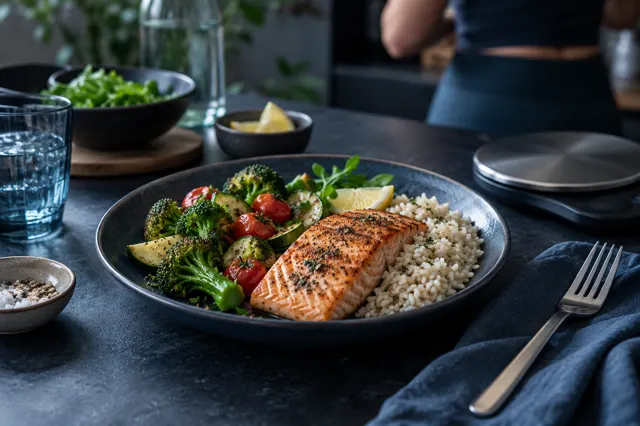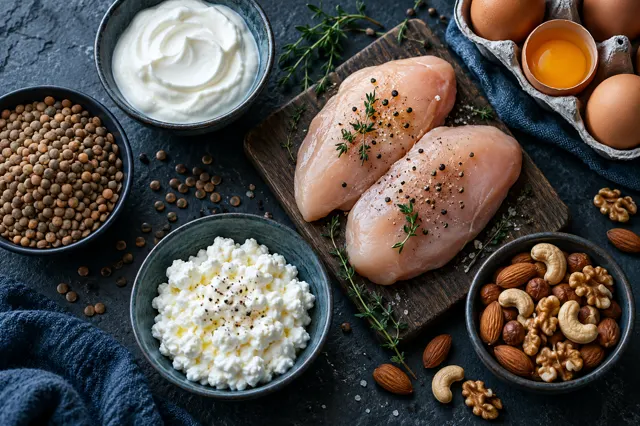
No nutrient attracts more myths than protein. Some people think muscle won’t grow without a shake the minute training ends; others worry they’re wrecking their kidneys. The science is actually pretty calm: there’s a clear target range, a few simple rules for spreading it out, and the main driver of muscle growth is still the training itself. In this article you’ll learn how much protein you need, how to calculate your number, which foods get you there, and what you can stop worrying about.
How much protein to build muscle
The general recommendation for adults who don’t train is about 0.8 g of protein per kilogram of body weight per day. That’s the minimum to avoid deficiency, not the optimum for someone lifting weights.
For people who train, sports science organizations publish position stands. The International Society of Sports Nutrition position stand on protein and exercise (2017) recommends 1.4–2.0 g of protein per kg of body weight per day for most exercising individuals. A meta-analysis by Morton and colleagues in the British Journal of Sports Medicine (2018) found that the extra fat-free mass gained from additional protein leveled off at around 1.6 g/kg on average (1.62 g/kg, to be precise), with the upper end of the 95% confidence interval near 2.2 g/kg.
In practice:
- 1.6 g/kg is a sensible baseline target for most people who want to build muscle;
- up to 2.0–2.2 g/kg for advanced lifters and for older adults, whose muscles respond less strongly to protein;
- in a calorie deficit, needs are higher: the ISSN allows 2.3–3.1 g/kg for trained people, and Helms and colleagues (2014) recommend 2.3–3.1 g per kg of lean body mass for lean athletes who are dieting;
- when building muscle, more than ~2.2 g/kg usually adds nothing extra and just crowds other foods off your plate.
If you carry a lot of excess weight, calculating from total body weight overshoots. Use your goal weight or your lean mass instead. You can learn how to estimate it in the article on body composition.
Spreading protein across meals
Muscle protein synthesis is triggered by individual servings of protein, not by your daily total as one lump. So how you eat it matters, not just how much.
- 0.25–0.4 g/kg per meal — about 20–40 g of protein for most adults. The ISSN cites 0.25 g/kg or 20–40 g; Schoenfeld and Aragon (2018) suggest about 0.4 g/kg across at least four meals for muscle building (up to 0.55 g/kg per meal).
- 3–5 meals a day, roughly every 3–4 hours.
- A serving before bed, such as cottage cheese or Greek yogurt, is a good option if you struggle to hit your number during the day.
The famous 30-minute “anabolic window” after training is greatly exaggerated. If you eat a protein-rich meal a couple of hours before or within a few hours after your workout, you’re covered. Daily total and consistency matter more.
Another myth: “Your body can only absorb 30 g of protein at once.” You absorb all of it; a large serving just takes longer to digest. What’s limited is the maximum stimulation of synthesis per meal, which is why spreading protein out still beats one giant serving at dinner.
Foods: protein per 100 grams
Approximate values (based on USDA FoodData Central and European food composition tables), raw unless noted; for a specific product, check the label. Meat loses water when cooked, so 100 g of cooked meat contains more protein.
| Food | Protein, g per 100 g |
|---|---|
| Chicken breast (raw) | 22–24 |
| Turkey breast | 22–24 |
| Lean beef | 20–23 |
| Salmon | 19–21 |
| Canned tuna in water | 23–26 |
| Egg (1 large ≈ 6–7 g) | 12–13 |
| Cottage cheese, low-fat | 11–13 |
| Greek yogurt, nonfat | 9–11 |
| Hard cheese | 23–30 |
| Firm tofu | 12–17 |
| Tempeh | 18–21 |
| Lentils, cooked | 8–9 |
| Chickpeas, cooked | 8–9 |
| Rolled oats | 12–14 |
| Whey protein powder | 70–90 |
Rule of thumb: a palm-sized portion of meat, fish or cottage cheese gives you roughly 20–30 g of protein.
Plant protein
You can absolutely build muscle on plant protein, with two caveats. First, many plant sources are a bit less digestible and contain less leucine, the amino acid that “switches on” muscle protein synthesis. Second, individual foods can be low in specific essential amino acids: legumes tend to be low in methionine, grains in lysine.
The fix is simple:
- combine legumes, grains, nuts and soy foods over the day;
- aim for the upper half of the range, closer to 1.8–2.0 g/kg;
- lean on tofu, tempeh and seitan, plus soy or pea protein if needed.
A meta-analysis by Messina and colleagues (2018) comparing soy with animal protein (mostly whey) alongside resistance training found no difference in gains in strength or lean mass.
Supplements: myths and facts
Protein powder is food in a convenient form — neither “chemicals” nor magic. It helps if you find it hard to reach your target with regular meals, but it isn’t mandatory.
- Myth: no shake, no muscle. Muscle grows fine if food covers your daily total.
- Myth: collagen works like whey. Collagen is low in leucine and lacks tryptophan, so it’s much weaker for building muscle.
- Myth: BCAAs replace complete protein. If you eat enough protein, isolated amino acids add nothing.
- Fact: creatine monohydrate is one of the most researched supplements for strength and muscle mass — but it isn’t protein and doesn’t replace your protein needs.
What about your kidneys?
In healthy people, the protein intakes recommended for athletes aren’t linked to worse kidney function: a meta-analysis by Devries and colleagues (2018) of 28 papers found no difference in the change in glomerular filtration rate between higher and normal protein intakes. Slightly higher urea levels or filtration rate on a high-protein diet are a normal adaptation, not a sign of disease. Just drink enough water.
It’s a different story with chronic kidney disease, diabetes affecting the kidneys and some other conditions: in those cases, work out your protein intake with your doctor.
Worked example
An 80 kg man trains three times a week and wants to build muscle on a small calorie surplus.
- Target: 1.8 g/kg × 80 kg = 144 g of protein per day.
- Four meals: 144 / 4 = about 36 g per meal (0.45 g/kg — within the 0.4–0.55 g/kg suggested by Schoenfeld and Aragon).
- What that can look like:
- breakfast: 3 eggs and 200 g cottage cheese — about 42 g;
- lunch: 150 g chicken breast with a side — about 35 g;
- dinner: 150 g salmon with lentils — about 40 g;
- snack: 200 g Greek yogurt — about 20 g.
That’s around 137 g — the target is essentially met without a single shake.
For a 60 kg woman aiming for 1.6 g/kg, that’s about 96 g a day — for example, four meals of 24 g.
Common mistakes
- Eyeballing protein and ending up 30–50% short.
- Eating almost all your protein at dinner.
- Prioritizing protein over training: without progressive overload, extra protein won’t turn into muscle.
- Cutting protein along with calories when dieting — that’s exactly when you need more. More on that in the article on a calorie deficit without the extremes.
How to tell it’s working
Your protein and training are paying off if the weights you lift climb over time and your lean mass increases or at least holds steady. The scale won’t show that, because its single number lumps together water, fat and muscle. In FitHilf you can log your weight and measurements, get an estimate of body fat and muscle mass, keep a training log with personal records and see your progress on charts. Try it in the dashboard — after 4–6 weeks of regular measurements you’ll see the first reliable trends.
Sources
- Jäger, R., Kerksick, C. M., Campbell, B. I., et al. (2017). International Society of Sports Nutrition Position Stand: protein and exercise. Journal of the International Society of Sports Nutrition, 14, 20. doi:10.1186/s12970-017-0177-8
- Morton, R. W., Murphy, K. T., McKellar, S. R., et al. (2018). A systematic review, meta-analysis and meta-regression of the effect of protein supplementation on resistance training-induced gains in muscle mass and strength in healthy adults. British Journal of Sports Medicine, 52(6), 376–384. doi:10.1136/bjsports-2017-097608
- Schoenfeld, B. J., & Aragon, A. A. (2018). How much protein can the body use in a single meal for muscle-building? Implications for daily protein distribution. Journal of the International Society of Sports Nutrition, 15, 10. doi:10.1186/s12970-018-0215-1
- Helms, E. R., Aragon, A. A., & Fitschen, P. J. (2014). Evidence-based recommendations for natural bodybuilding contest preparation: nutrition and supplementation. Journal of the International Society of Sports Nutrition, 11, 20. doi:10.1186/1550-2783-11-20
- Messina, M., Lynch, H., Dickinson, J. M., & Reed, K. E. (2018). No difference between the effects of supplementing with soy protein versus animal protein on gains in muscle mass and strength in response to resistance exercise. International Journal of Sport Nutrition and Exercise Metabolism, 28(6), 674–685. doi:10.1123/ijsnem.2018-0071
- Devries, M. C., Sithamparapillai, A., Brimble, K. S., et al. (2018). Changes in kidney function do not differ between healthy adults consuming higher- compared with lower- or normal-protein diets: a systematic review and meta-analysis. The Journal of Nutrition, 148(11), 1760–1775. doi:10.1093/jn/nxy197
- U.S. Department of Agriculture, Agricultural Research Service. FoodData Central. fdc.nal.usda.gov
FAQ
Do I need a protein shake right after training?
No. A protein-rich meal a couple of hours before or within a few hours after training is enough; your daily total matters more than exact timing.
Can I build muscle on a vegan diet?
Yes. Combine legumes, grains and soy foods and aim closer to 1.8–2.0 g/kg to offset the slightly lower digestibility of plant protein.
Should I calculate from total weight or lean mass?
At a normal weight, use total body weight. With significant excess weight, your goal weight or lean mass is more accurate; otherwise you’ll overestimate your needs.
What happens if I eat more than 2.2 g/kg?
It won’t harm a healthy person, but it usually won’t build extra muscle either. The surplus protein is simply used for energy.