Your scale gives you one number: total body mass. It can’t tell a pound of fat from a pound of muscle or water, so it says very little about what’s actually changing. Body fat percentage tells you much more. The good news: you don’t need a DEXA scan or underwater weighing to get a reasonable estimate. In this article you’ll learn how to use the U.S. Navy tape method, how to take skinfolds with a caliper, how accurate both really are, and why smart scales deserve a healthy dose of skepticism.
Why body fat percentage beats body weight
Two people who are both 178 cm and 82 kg can look completely different: one at 12% body fat, the other at 28%. Their BMI is identical; their body composition, health and performance are not. We dig into this in why body composition matters more than weight.
Body fat percentage lets you calculate two key numbers:
- Fat mass = weight × body fat % / 100
- Lean mass = weight − fat mass
If your weight stays flat at 82 kg for two months while body fat drops from 24% to 21%, you’ve lost roughly 2.5 kg of fat and gained about the same amount of muscle and water. The scale shows none of it.
The U.S. Navy method: a tape instead of a machine
Hodgdon and Beckett developed this method at the Naval Health Research Center in 1984 to quickly estimate body composition in Navy personnel. All you need is your height and a few circumferences. In a cross-validation on an independent sample of men, its standard error was about 2.7 percentage points against underwater weighing (NHRC Report No. 84-11).
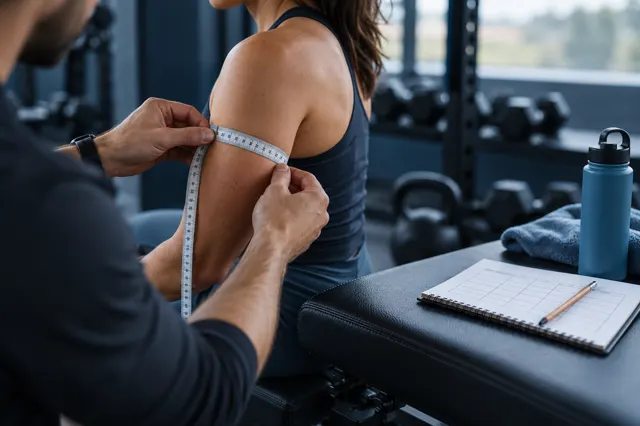
Where and how to measure
- Neck — just below the larynx (Adam’s apple), with the tape sloping slightly downward toward the front. Don’t flex your neck or drop your chin.
- Waist, men — horizontally at the level of the navel, at the end of a relaxed exhale. Don’t suck in.
- Waist, women — at the narrowest point of the torso, usually between the lowest rib and the navel. If there’s no visible narrowing, measure halfway between the lowest rib and the top of the hip bone.
- Hips (women only) — horizontally around the widest part of the buttocks, feet together.
- Height — barefoot, against a wall, looking straight ahead.
Round to the nearest 0.5 cm and take every measurement twice. If the two differ by more than 1 cm, take a third and average the two closest. For technique on every site, see our body measurements guide.
The formulas (metric, all values in centimeters)
Men: Body fat % = 495 / (1.0324 − 0.19077 × log10(waist − neck) + 0.15456 × log10(height)) − 450
Women: Body fat % = 495 / (1.29579 − 0.35004 × log10(waist + hip − neck) + 0.22100 × log10(height)) − 450
The “495 / … − 450” part is the Siri equation, which converts body density into body fat percentage.
Worked example
A man: 180 cm tall, neck 38 cm, waist 88 cm.
- Waist − neck = 50; log10(50) ≈ 1.6990.
- log10(180) ≈ 2.2553.
- Denominator: 1.0324 − 0.19077 × 1.6990 + 0.15456 × 2.2553 ≈ 1.0324 − 0.3241 + 0.3486 = 1.0569.
- 495 / 1.0569 ≈ 468.4; 468.4 − 450 = about 18.4% body fat.
A woman: 165 cm tall, neck 32 cm, waist 72 cm, hips 98 cm. Waist + hip − neck = 138. Plugging in gives a denominator of about 1.0368 and about 27.4% body fat.
Notice how sensitive the formula is to the waist: if the man in the example loses 2 cm off his waist with the same neck, his estimate drops by roughly 1.5 percentage points.
Calipers: the skinfold method
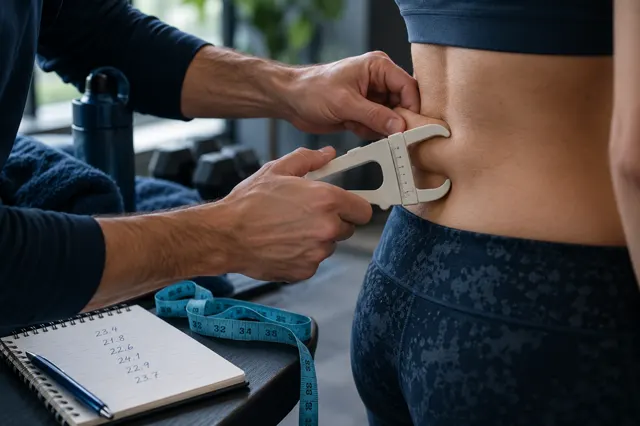
A caliper measures the thickness of a skinfold in millimeters. The sum of several sites goes into a body density equation and then into the same Siri formula. The most widely used protocol is the 3-site Jackson-Pollock method (equations by Jackson & Pollock 1978 for men and Jackson, Pollock & Ward 1980 for women):
| Men | Women | |
|---|---|---|
| Site 1 | Chest — diagonal fold halfway between the front armpit crease and the nipple | Triceps — vertical fold on the back of the upper arm, midway |
| Site 2 | Abdomen — vertical fold 2 cm to the side of the navel | Suprailiac — diagonal fold just above the hip bone |
| Site 3 | Thigh — vertical fold on the front, midway | Thigh — vertical fold on the front, midway |
Technique
- Measure on the right side of the body, standing, muscles relaxed.
- Pinch the fold with thumb and index finger so it contains skin and fat but no muscle. Roll it gently — muscle will slip out.
- Place the caliper jaws about 1 cm from your fingers and read the dial after 1–2 seconds, without letting go of the fold.
- Take 2–3 readings per site and average them.
- Don’t measure right after training, a shower or a sauna — increased blood flow thickens the folds.
The main challenge with calipers is skill. Early on, your readings may vary by several millimeters; after 10–20 practice sessions they stabilize. A cheap plastic caliper works fine as long as you always use the same one.
How accurate is this, really?
No field method gives you the true value — each one estimates it from indirect markers. Rough accuracy compared with lab methods:
| Method | Typical error | Biggest source of error |
|---|---|---|
| DEXA (reference) | ±1–2 points | Hydration, scanner model |
| U.S. Navy formula | ±3–4 points | Waist and neck technique, body type |
| Calipers (3 sites, skilled) | ±3–4 points | Skill, choice of equation |
| Bioimpedance scale | ±4–8 points | Water, food, time of day |
| Deurenberg (BMI-based) | ±4–5 points | Muscle mass — overestimates in athletes |
For context: in the original papers, the standard error was roughly 3.4–3.8% body fat for the Jackson-Pollock equations and 4.1% for the Deurenberg formula. The figures for bathroom scales are a rough estimate — accuracy depends heavily on the model and the manufacturer’s formulas.
The Navy formula tends to be off when fat is distributed atypically: very muscular people with thick necks, or people who store most fat on their thighs. Calipers get less reliable at higher body fat levels because the fold is hard to grab. Combining two methods at least tells you whether the trend points the same way.
Bioimpedance scales: why the numbers jump
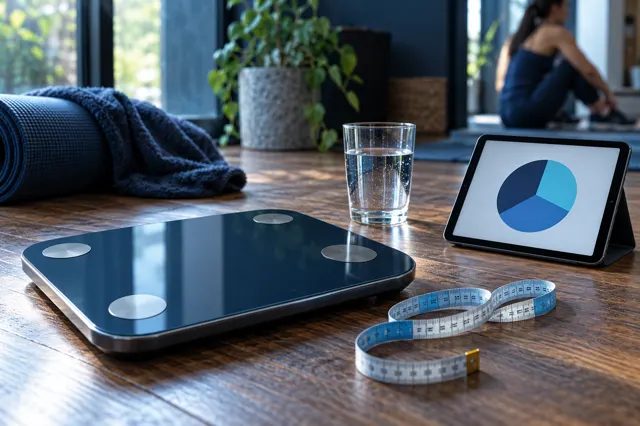
These scales send a weak current through your feet and measure resistance. Fat conducts worse than water-rich muscle — but the scale mostly “sees” your lower body and extrapolates using the manufacturer’s formulas. A big glass of water, a heavy dinner, a workout or alcohol can shift the reading by several points. If you use one, step on it only in the morning, fasted, after using the bathroom, and watch the weekly average rather than individual days.
Consistency rules for comparable numbers
For tracking progress, repeatability matters more than absolute accuracy. A systematic error of 3 points won’t hide a real 2-point drop as long as the error is the same every time.
- Same time: morning, fasted, after using the bathroom.
- Same tools: the same tape, the same caliper.
- Same person measuring whenever possible.
- Not after training, a sauna, or the day after a very salty meal.
- Every 2–4 weeks — more often is pointless, since real change is smaller than the error.
- Log raw data (circumferences, skinfolds), not just the final percentage.
Women should factor in the menstrual cycle: water retention in the second half can add 1–2 cm to the waist. Compare measurements from the same phase. If you’re pregnant or have a thyroid, kidney or heart condition, it’s best to discuss body composition assessment with your doctor.
Let FitHilf do the math
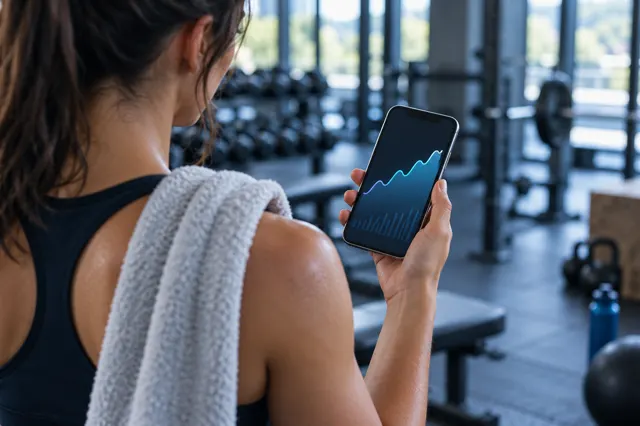
You don’t have to crunch logarithms by hand. In FitHilf you enter height, weight and circumferences, and the app automatically calculates body fat with both the U.S. Navy formula and the Deurenberg formula, showing a combined estimate when there’s enough data. You also get fat mass, lean mass, BMI and a dated history, so the trend is visible without spreadsheets. To learn how to interpret those curves, read tracking progress with charts, not the scale.
Calculate your body fat in the dashboard — all sections are currently free.
Sources
- Hodgdon, J. A., & Beckett, M. B. (1984). Prediction of percent body fat for U.S. Navy men from body circumferences and height (Report No. 84-11). Naval Health Research Center. DTIC ADA143890
- Hodgdon, J. A., & Beckett, M. B. (1984). Prediction of percent body fat for U.S. Navy women from body circumferences and height (Report No. 84-29). Naval Health Research Center. DTIC ADA146456
- Jackson, A. S., & Pollock, M. L. (1978). Generalized equations for predicting body density of men. British Journal of Nutrition, 40(3), 497–504. doi:10.1079/bjn19780152
- Jackson, A. S., Pollock, M. L., & Ward, A. (1980). Generalized equations for predicting body density of women. Medicine and Science in Sports and Exercise, 12(3), 175–181. PubMed 7402053
- Deurenberg, P., Weststrate, J. A., & Seidell, J. C. (1991). Body mass index as a measure of body fatness: age- and sex-specific prediction formulas. British Journal of Nutrition, 65(2), 105–114. doi:10.1079/bjn19910073
FAQ
Which is more accurate, the Navy formula or calipers?
On average they’re comparable, at about 3–4 percentage points of error. Calipers win in skilled hands; the Navy formula is simpler and more repeatable for beginners.
How often should I measure body fat?
Every 2–4 weeks is enough. Any real change over a few days is smaller than the method’s error, so measuring more often just adds noise.
Why does my smart scale show a different body fat number every day?
Bioimpedance depends heavily on body water. Food, drinks, exercise and time of day shift the reading by several points even though your fat mass barely changes.
Does the Navy formula work for lifters?
With caveats. A very thick neck and lots of muscle can make it underestimate body fat, so use it mainly to track the trend and cross-check with calipers or the mirror.