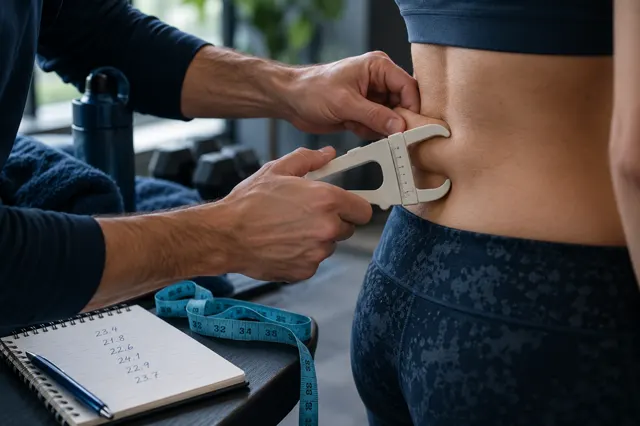
In the morning the scale reads 74.2 kg; by evening, 75.6. After a week of eating well and training hard, you’re a kilo heavier. Sound familiar? The problem isn’t you — it’s the tool. A scale measures your whole body and has no idea what actually changed. In this article you’ll learn what your weight is made of, why it swings 1–2 kg without any change in fat, what recomposition is, where BMI falls short, and which metrics to track instead of a single number.
What your weight is made of
At its simplest, your body can be split into two compartments:
- Fat mass — storage fat under the skin and around the organs, plus a small amount of essential fat your hormones and nervous system need.
- Fat-free (lean) mass — everything else: muscle, bone, organs, blood and water.
Water is the most mobile component. In adults it makes up roughly 50–60% of body weight. Muscle tissue is about three-quarters water, while fat tissue holds much less. That’s why every shift in fluid balance shows up on the scale right away.
An example: two people each weigh 80 kg. The first has 15% body fat — 12 kg of fat and 68 kg of lean mass. The second has 30% — 24 kg of fat and 56 kg of lean mass. Same weight, yet a 12 kg difference in both fat and lean tissue. To estimate your own body fat without a lab, read how to measure body fat without devices.
Why your weight jumps 1–2 kg
Glycogen and water
Your muscles and liver store carbohydrate as glycogen: typically around 400–500 g in muscle and up to 100 g in the liver. Each gram of glycogen is stored in muscle with at least 3 g of water — a classic ratio that muscle biopsies in Fernández-Elías et al. (2015) confirmed. Cut carbs sharply and those stores drain within a few days — taking 1–2 kg of water with them. That’s why the first week of a low-carb diet brings an “impressive” drop that then stalls. The reverse is true too: after a carb-heavy dinner, you’ll weigh more the next morning.
Salt, food and digestion
Salty food temporarily holds water in the body. The contents of your stomach and intestines can weigh anywhere from a few hundred grams to 1–2 kg depending on how much and what you ate. A big dinner can easily add a kilo to your morning weigh-in.
Training
New or hard training causes micro-damage in muscle, and the repair process temporarily holds on to extra water. After returning to training or switching programs, your weight may sit 0.5–1.5 kg higher for a week or two — completely normal.
The menstrual cycle
For women, water retention in the second half of the cycle often adds 1–2 kg. More on this in female physiology and body composition.
Fat math
One kilogram of fat tissue corresponds to about 7,700 kcal. To gain 1 kg of fat in a single day, you’d need to eat roughly 7,700 kcal above your needs — several extra days’ worth of food. A kilo overnight is water and food, not fat. Keep in mind that this is only a rule of thumb: when you lose weight you also lose some lean mass and your metabolism adapts, so actual weight loss drifts away from the simple calculation over time (Hall, 2008).
Recomposition: losing fat without losing weight
Recomposition means losing fat and building muscle at the same time. Your weight may barely move while your body visibly changes.
Example: over three months, weight goes from 75 to 74 kg and body fat from 27% to 23%. Fat mass: 75 × 0.27 ≈ 20.25 kg → 74 × 0.23 ≈ 17.0 kg, a loss of about 3.2 kg of fat. Lean mass: 54.75 → 57.0 kg, a gain of 2.2 kg. The scale shows just one kilo down.
Recomposition works best for:
- beginners to strength training,
- people returning after a break,
- people with relatively high body fat.
What it takes:
- Resistance training 2–4 times a week with gradually increasing load.
- Enough protein. The International Society of Sports Nutrition position stand (2017) recommends 1.4–2.0 g of protein per kg of body weight per day for active people; in a calorie deficit, aim toward the upper end.
- Calories around maintenance or a modest deficit of 10–20%. For how to do that without going to extremes, see a calorie deficit without the fanaticism.
- At least 7 hours of sleep — the minimum the AASM and SRS recommend for adults; without it, recovery and muscle growth suffer.
The flip side: on a harsh diet without strength training, a substantial share of the weight you lose can be muscle. The scale looks great, but your body gets softer and weaker.
Where BMI falls short
Body mass index = weight (kg) / height (m)². The WHO classifies 18.5–24.9 as normal weight, 25 or more (25–29.9) as overweight and 30 or more as obesity (WHO).
BMI is useful for screening large populations, but for you as an individual it has three blind spots:
- It can’t tell muscle from fat. A muscular person who is 180 cm and 90 kg has a BMI of 27.8 — “overweight” — even at 13% body fat.
- It misses “normal weight with high body fat.” Someone with a BMI of 23 can still have little muscle and elevated body fat.
- It ignores fat distribution. Visceral belly fat carries more risk than subcutaneous fat on the thighs, which is why waist circumference and waist-to-height ratio matter.
There are no universally accepted body fat norms; reference ranges vary by source and age. For example, Gallagher et al. (2000), who linked ranges to a healthy BMI, give roughly 8–20% for men and 21–33% for women as healthy in white adults aged 20–39, with the limits shifting upward with age. If you have a chronic condition or are pregnant, it’s best to discuss body composition goals with your doctor.
Why muscle is worth the effort
- Strength and function. Lifting, carrying and climbing stairs get easier.
- Metabolism. A kilo of muscle burns more energy at rest than a kilo of fat, though the difference is smaller than often promised.
- Insulin sensitivity. Muscle is the body’s largest glucose consumer, and more of it helps with blood sugar control.
- Healthy aging. Muscle mass declines with age, and strength training is the most effective way to slow that down.
What to track instead of one number
| Metric | How often | What it tells you |
|---|---|---|
| Weight (7-day average) | Daily in the morning, watch the average | Overall trend without daily noise |
| Circumferences (waist, hips, arms, etc.) | Every 2–4 weeks | Where fat is leaving and muscle is growing |
| Body fat percentage | Every 2–4 weeks | Ratio of fat mass to lean mass |
| Strength numbers | Every workout | Whether muscle is being kept or built |
| Photos in the same lighting | Every 4 weeks | Visual changes the numbers miss |
A simple rule: if your average weight holds steady while your waist shrinks and your lifts go up, you’re on the right track.
Seeing it all in FitHilf
FitHilf stores your weight, height and 11 circumferences with a dated history, and automatically calculates body fat with the U.S. Navy and Deurenberg formulas, along with fat mass, lean mass and BMI. Right next to that is your workout log with personal records and progress charts — so you see body composition and strength on one screen instead of just the number on the scale.
Start tracking your body composition in the dashboard — all sections are currently free.
Sources
- Olsson, K. E., & Saltin, B. (1970). Variation in total body water with muscle glycogen changes in man. Acta Physiologica Scandinavica, 80(1), 11–18. doi:10.1111/j.1748-1716.1970.tb04764.x
- Fernández-Elías, V. E., Ortega, J. F., Nelson, R. K., & Mora-Rodriguez, R. (2015). Relationship between muscle water and glycogen recovery after prolonged exercise in the heat in humans. European Journal of Applied Physiology, 115(9), 1919–1926. doi:10.1007/s00421-015-3175-z
- Hall, K. D. (2008). What is the required energy deficit per unit weight loss? International Journal of Obesity, 32(3), 573–576. doi:10.1038/sj.ijo.0803720
- Jäger, R., Kerksick, C. M., Campbell, B. I., et al. (2017). International Society of Sports Nutrition Position Stand: protein and exercise. Journal of the International Society of Sports Nutrition, 14, 20. doi:10.1186/s12970-017-0177-8
- Watson, N. F., Badr, M. S., Belenky, G., et al. (2015). Recommended Amount of Sleep for a Healthy Adult: A Joint Consensus Statement of the American Academy of Sleep Medicine and Sleep Research Society. Sleep, 38(6), 843–844. doi:10.5665/sleep.4716
- Gallagher, D., Heymsfield, S. B., Heo, M., Jebb, S. A., Murgatroyd, P. R., & Sakamoto, Y. (2000). Healthy percentage body fat ranges: an approach for developing guidelines based on body mass index. American Journal of Clinical Nutrition, 72(3), 694–701. doi:10.1093/ajcn/72.3.694
- World Health Organization (2025). Obesity and overweight (fact sheet). WHO. who.int
FAQ
Why am I gaining weight even though I’m training?
In the first weeks your muscles store more water and glycogen for recovery. If your waist isn’t growing and your strength is improving, that isn’t fat gain.
Can I lose fat and build muscle at the same time?
Yes, that’s recomposition. It works best for beginners, people returning after a break and those with higher body fat – with resistance training and enough protein.
How often should I weigh myself?
Daily in the morning is fine, but judge the weekly average. If daily numbers stress you out, once or twice a week under the same conditions is enough.
Is BMI worth looking at at all?
As a rough guide, yes, ideally together with waist circumference. For very muscular people or for judging training progress, it tells you little.