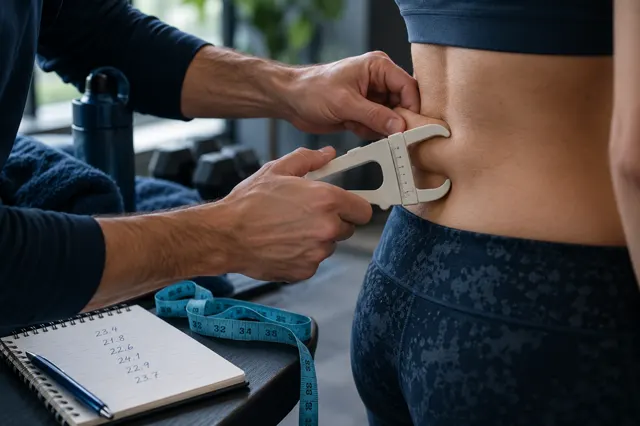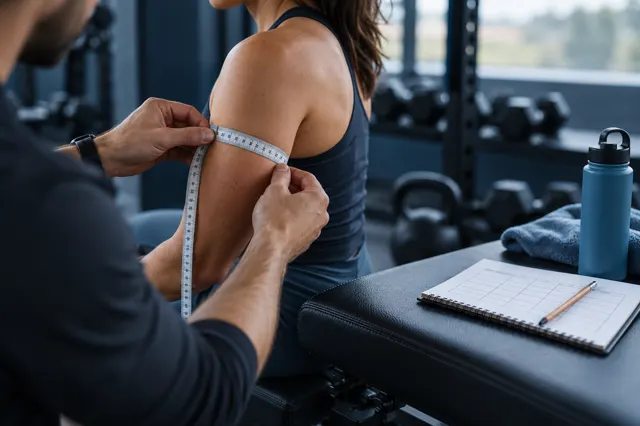
Body weight is a blunt tool. The scale lumps together fat, muscle, water and whatever is in your gut, then hands you a single number. Circumferences work differently: they show you where your body is changing. Waist down 3 cm while shoulders and thighs go up? You’re losing fat and building muscle at the same time, even if the scale hasn’t moved. In this guide you’ll learn the 11 key measurement sites, the exact anatomical landmarks, proper tape technique, and how to interpret your results, including waist-to-hip and waist-to-height ratios.
What you need
- A soft, non-stretch tape measure. A sewing tape works but stretches over time — check it against a rigid ruler once a year. Tapes with a spring-lock mechanism are handy because they apply the same tension every time.
- A mirror or a helper. The tape has to stay parallel to the floor all the way around, and you can’t see your back.
- A place to log your numbers. Notebook, spreadsheet or app — what matters is that everything is stored by date.
The 11 sites: exactly where to measure
| Measurement | Landmark | Position |
|---|---|---|
| Neck | Just below the larynx (Adam’s apple), tape sloping slightly down at the front | Head level, neck relaxed |
| Shoulders | Around the outermost points of the deltoids | Arms relaxed at your sides, tape horizontal |
| Biceps, left / right | Midway between the top of the shoulder and the elbow | Arm hanging relaxed |
| Chest | Men at nipple level; women around the fullest part of the bust | End of a relaxed exhale |
| Waist (belly) | Men at navel level; women at the narrowest part of the torso | End of a relaxed exhale, don’t suck in |
| Hips (glutes) | Widest part of the buttocks | Feet together |
| Thigh, left / right | About 1 cm below the gluteal fold, at the widest point | Feet shoulder-width apart, weight on both legs |
| Calf, left / right | Widest part of the lower leg | Standing, weight evenly distributed |
Two things need explaining. First, you can measure biceps relaxed or flexed — pick one and stick with it. Relaxed is more repeatable. Second, the waist has several definitions. The WHO uses the midpoint between the lowest rib and the top of the hip bone for health risk, while the U.S. Navy formula uses navel level for men and the narrowest point for women. If you estimate body fat from circumferences (see how to measure body fat without devices), use the Navy landmarks. The difference is usually 1–2 cm; what matters is not mixing them.
Technique: how to hold the tape
- Strip down to underwear. Clothing adds 0.5 to 2 cm and varies from day to day.
- Keep the tape parallel to the floor all the way around. If it dips a few centimeters at the back, you can easily read 1–2 cm too high.
- Snug, not tight. The tape rests on the skin without leaving a dent. If the skin bunches up, you’re pulling too hard.
- Don’t flex or suck in — unless you’re deliberately measuring a flexed biceps.
- Read the tape straight on, not from above, to avoid parallax error.
- Two readings per site. If they differ by more than 0.5–1 cm, take a third and average the two closest.
- Measure both sides separately. A 0.5–1.5 cm difference between left and right is normal; your dominant arm is usually bigger.
In practice, people who measure themselves see up to 1 cm of variation at the same site. With a helper and consistent technique, that drops to 0.5 cm or less.
When and how often to measure
Timing: morning, fasted, after using the bathroom, before training. After a meal your waist can easily gain 1–3 cm, and after a workout “pumped” muscles are temporarily 0.5–1 cm bigger from increased blood flow.
Frequency: every 2–4 weeks. Your waist does shrink along with your weight — in the study by Han et al. (1997), weight loss was closely related to waist reduction — but at a sensible rate of loss, weekly changes are on the order of the measurement error and vanish in the noise. Muscle gain is even slower: an extra 0.5 cm on the biceps in a month is a solid result for a trained person.
Cycle: women should compare measurements taken in the same phase of the menstrual cycle. Water retention in the second half can add 1–2 cm to the waist and hips.
How to read the changes
Don’t fixate on one number — look at circumferences and weight together:
| What you see | Likely explanation |
|---|---|
| Waist ↓, weight ↓, arms and legs roughly stable | Clean fat loss, muscle preserved |
| Waist ↓, weight flat, shoulders / arms ↑ | Recomposition: fat down, muscle up |
| Everything ↑, waist rising fastest | Calorie surplus too large, you’re adding fat |
| Everything ↓ including arms and legs, strength dropping | Deficit too aggressive or too little protein — muscle loss |
| Jumps of 2–3 cm within a few days | Water, salt, food, cycle — not real change |
For more on why composition matters more than the number on the scale, read body composition vs. weight.
Ratios: waist-to-hip and waist-to-height
Circumferences alone describe your shape. Ratios help you gauge health risk linked to visceral (deep abdominal) fat.
Waist-to-height ratio (WHtR)
Waist (cm) / height (cm). The rule of thumb the UK’s NICE introduced in 2022 and kept in its current guideline NG246: keep your waist to less than half your height, meaning a WHtR below 0.5. Per NICE, 0.4–0.49 indicates no increased health risk, 0.5–0.59 increased risk, and 0.6 or more further increased risk. These cut-offs apply to adults with a BMI under 35, of both sexes and all ethnicities, including people with high muscle mass.
Example: height 176 cm, waist 84 cm → 84 / 176 ≈ 0.48. A good result.
Waist-to-hip ratio (WHR)
Waist / hips. According to the 2008 WHO expert consultation, 0.90 or more in men and 0.85 or more in women indicates a substantially increased risk of metabolic complications.
Example: a woman with a 74 cm waist and 100 cm hips → 0.74. Low risk.
For risk assessment, the WHO recommends measuring the waist midway between the lowest rib and the top of the hip bone. If you measure at the navel, your number may differ slightly, so treat these ratios as guidance, not a diagnosis. They don’t replace a checkup: if your waist is growing quickly or you have health concerns, talk to your doctor.
Measurement checklist
- Non-stretch tape, the same one every time.
- Morning, fasted, after using the bathroom, before training.
- Underwear or nothing, in front of a mirror or with a helper.
- Tape parallel to the floor, snug, no dent.
- Two readings per site, log the average.
- Both sides for arms, thighs and calves.
- Every 2–4 weeks, in the same cycle phase.
Track your history in FitHilf
Measurements only pay off when you can see them over time. FitHilf includes all 11 circumferences from this guide — from neck to left and right calf — with a dated history. From your neck, waist, hips and height, the app automatically calculates body fat with the U.S. Navy formula, plus fat mass, lean mass and BMI. To learn how to read the resulting charts without panicking over single data points, see tracking progress with charts.
Log your first measurements in the dashboard — all sections are currently free.
Sources
- World Health Organization (2011). Waist circumference and waist-hip ratio: report of a WHO expert consultation, Geneva, 8–11 December 2008. WHO. who.int
- Nishida, C., Ko, G. T., & Kumanyika, S. (2010). Body fat distribution and noncommunicable diseases in populations: overview of the 2008 WHO Expert Consultation on Waist Circumference and Waist-Hip Ratio. European Journal of Clinical Nutrition, 64(1), 2–5. doi:10.1038/ejcn.2009.139
- National Institute for Health and Care Excellence (2025). Overweight and obesity management (NICE guideline NG246; waist-to-height recommendations from 2022). NICE. nice.org.uk
- Ashwell, M., Gunn, P., & Gibson, S. (2012). Waist-to-height ratio is a better screening tool than waist circumference and BMI for adult cardiometabolic risk factors: systematic review and meta-analysis. Obesity Reviews, 13(3), 275–286. doi:10.1111/j.1467-789X.2011.00952.x
- Han, T. S., Richmond, P., Avenell, A., & Lean, M. E. (1997). Waist circumference reduction and cardiovascular benefits during weight loss in women. International Journal of Obesity and Related Metabolic Disorders, 21(2), 127–134. doi:10.1038/sj.ijo.0800377
- Hodgdon, J. A., & Beckett, M. B. (1984). Prediction of percent body fat for U.S. Navy men from body circumferences and height (Report No. 84-11). Naval Health Research Center. DTIC ADA143890
FAQ
Should I measure my biceps flexed or relaxed?
Either works as long as you’re consistent. Relaxed at mid-arm is more repeatable; flexed shows muscle growth more vividly.
Why does my waist measurement change during the day?
Food, fluids, gas and posture shift it by 1–3 cm. That’s why you measure your waist in the morning, fasted, at the end of a relaxed exhale.
Is it normal for my left and right arms to differ?
Yes. Most people have a 0.5–1.5 cm difference, usually favoring the dominant side. Just track each side separately.
Which matters more for health, waist-to-height or waist-to-hip?
Both relate to visceral fat. Waist-to-height is simpler and works for any height (per NICE, with a BMI under 35): aim for a value below 0.5.