The home-vs-gym debate is usually framed as if there were one right answer for everyone. In reality, three things decide it: your goal, your budget and how consistently you can train. In this article you’ll get a breakdown by goal, three tiers of home equipment with rough prices, an honest look at where progress stalls at home, a quick decision table, and clear signs that it’s time to switch.
Start with the goal, not the place
General fitness and health
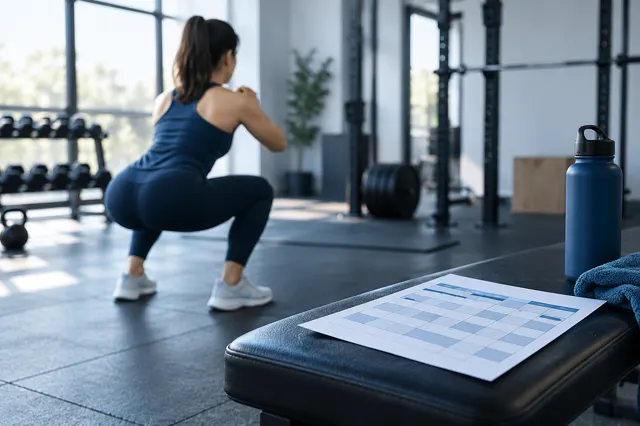
The World Health Organization’s 2020 guidelines recommend that adults get 150–300 minutes of moderate aerobic activity per week plus muscle-strengthening work for all major muscle groups on at least 2 days. Your living room handles that perfectly: squats, lunges, push-ups, band rows, pull-ups and planks cover every major muscle. If your goal is to feel more energetic, sleep better, maintain your weight and keep back pain away, you don’t need a gym.
Muscle growth (hypertrophy)
A meta-analysis by Schoenfeld and colleagues (2017) found that when sets are taken to failure, muscles grow about equally well with heavy (above 60% of max) and light loads — in other words, across a wide range of roughly 5 to 30+ reps — while maximal strength improves more with heavy loads. In practice, ending each set 0–3 reps short of failure is the usual advice. That’s good news for home training: 20 reps with a 16 kg dumbbell can be just as effective for muscle growth as 8 reps with a heavier weight. What matters is that sets are genuinely hard and volume is sufficient: in a meta-analysis by Schoenfeld, Ogborn and Krieger (2017), muscle gains rose with weekly volume, and the authors concluded that at least 10 sets per muscle group per week are needed to maximize growth; in practice, people often aim for 10–20 hard sets.
Maximal strength
Want to squat 120 kg or bench 100 kg? You need a barbell. Strength is specific: it improves in the exact movement and load range you train. Dumbbells and bands will make you noticeably stronger, but personal records in the big lifts require heavy, finely adjustable loads — a rack, a bar and plates.
Home equipment: three budget tiers
Prices are rough estimates for new gear in Europe as of 2026, not survey data: they vary a lot by brand, retailer and sales, and used equipment is often much cheaper.
| Tier | What’s included | Rough budget | Best for |
|---|---|---|---|
| Starter | Resistance bands, mat, doorway pull-up bar | €40–100 | Beginners, general fitness |
| Core | Adjustable dumbbells up to 20–24 kg per hand, pull-up bar, bands, folding bench | €150–400 | Muscle gain, recomposition |
| Full | Power rack, Olympic barbell, 100–150 kg of plates, bench, flooring | €800–2,000+ | Strength, long-term training |
A few practical buying tips:
- Adjustable dumbbells are the best first investment. They replace 10–15 pairs of fixed dumbbells and take up the space of a single shelf. Buy with headroom: women typically do well with 12–20 kg per hand, men with 20–32 kg.
- A pull-up bar gives you the best back exercise, one that bands can’t really replace. If you can’t do a pull-up yet, start with negatives (lowering yourself over 3–5 seconds) and band-assisted reps.
- Bands are great for warm-ups, rows and lateral raises, but resistance increases as they stretch, so tracking progress precisely is harder than with dumbbells.
- Before buying a rack, check your floor, ceiling height and the neighbors below: a rack needs roughly 2.3 m of clearance and a stable base.
Where progress stalls at home
The principle of progressive overload applies everywhere: to keep improving, the load has to increase gradually. The problem at home is simply that your dumbbells top out. Legs usually outgrow the equipment first: your quads and glutes carry your body weight all day and adapt quickly to 20 kg dumbbells.
Once you’ve maxed out the weight, pull other levers:
- More reps — up to 20–30 per set, as long as you get close to failure.
- Unilateral work — Bulgarian split squats and single-leg Romanian deadlifts substantially increase the load on the working leg with the same dumbbells.
- Tempo and pauses — lower over 3–4 seconds, pause 2 seconds at the bottom.
- Greater range of motion — push-ups on handles, deficit lunges from a step.
- Shorter rest or more sets — without endlessly piling on volume.
Here’s an example. You’re doing goblet squats with a 24 kg dumbbell for 3 sets of 15 and barely feel it. Next step: Bulgarian split squats holding two 12 kg dumbbells. The load per leg is much higher, and you’ll keep progressing for several more months. You’ve hit the ceiling when even single-leg variations allow 25+ easy reps — beyond that, progress without heavy weights becomes slow.
Gym pros and cons
Pros:
- virtually unlimited loads and increments of 1–2.5 kg;
- machines, cables and racks let you train safely close to failure;
- the atmosphere and the people around you keep many lifters disciplined;
- you can ask a coach to check your technique.
Cons:
- memberships in Germany, as a rough estimate, usually run €20–60 per month (some are cheaper, some much pricier) — over a year, about the price of a core home setup;
- a 15–20-minute commute each way turns a one-hour workout into an hour and a half;
- equipment is often taken during peak hours;
- for some beginners, the unfamiliar environment is a real barrier.
The hybrid approach
You don’t have to pick just one. A proven setup for busy people:
- 2 gym days — heavy compound lifts: squat, deadlift, bench press, barbell rows.
- 1–2 home days — pull-ups, push-ups, dumbbell work for arms and shoulders, core.
- Home during “bad” weeks — business trips, a sick kid, a deadline: a 25-minute dumbbell session preserves both skill and muscle.
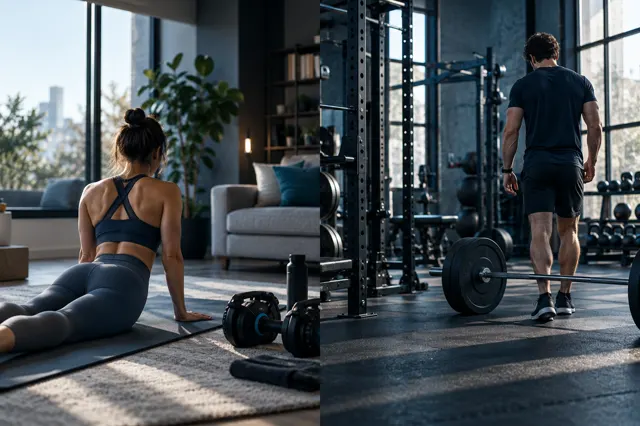
The hybrid approach reduces the biggest threat to progress: missed sessions. If you don’t have a template yet, start with the beginner workout plan and assign each day to a location.
Quick decision table
| Your situation | Recommendation |
|---|---|
| Goal is health and fitness, little time | Home, core setup |
| Want to build muscle on a tight budget | Home with adjustable dumbbells, gym later |
| Goal is strength in squat, bench, deadlift | Gym or a home rack |
| You need outside motivation and like the vibe | Gym |
| Young kids, unpredictable schedule | Home or hybrid |
| Gym 5 minutes from home or work | Gym, home as a backup |
When it’s time to switch
Signs that you’ve hit the ceiling at home:
- for 4–6 weeks neither weights nor reps have gone up in your key exercises, even though sleep and nutrition are on point;
- you can do 25+ reps on single-leg exercises;
- you want to build strength in the barbell lifts;
- training has become boring, and you’ve started skipping sessions.
Switching back is just as valid: if the gym eats so much time that you go once a week instead of three times, three home sessions will get you further. Whenever you change formats, plan 1–2 weeks of moderate loads to learn technique, and don’t skip your warm-up — new movements and heavy loads raise injury risk most in the first weeks. If you have joint pain or a chronic condition, discuss your training load with a doctor.
Decide based on data
The best way to know whether your setup works is to track your training and your body. In the FitHilf dashboard you can build a weekly plan, log sets, reps and weights, see personal records and progress charts, and record your body measurements. If the numbers are climbing after 8–12 weeks, your format works. If not, you’ll have the data to calmly decide what to change: the place, the program or your recovery.
Sources
- Bull, F. C., Al-Ansari, S. S., Biddle, S., et al. (2020). World Health Organization 2020 guidelines on physical activity and sedentary behaviour. British Journal of Sports Medicine, 54(24), 1451–1462. doi:10.1136/bjsports-2020-102955
- Schoenfeld, B. J., Grgic, J., Ogborn, D., & Krieger, J. W. (2017). Strength and hypertrophy adaptations between low- vs. high-load resistance training: a systematic review and meta-analysis. Journal of Strength and Conditioning Research, 31(12), 3508–3523. doi:10.1519/JSC.0000000000002200
- Schoenfeld, B. J., Ogborn, D., & Krieger, J. W. (2017). Dose-response relationship between weekly resistance training volume and increases in muscle mass: a systematic review and meta-analysis. Journal of Sports Sciences, 35(11), 1073–1082. doi:10.1080/02640414.2016.1210197
FAQ
Can I build muscle training only at home?
Yes, if you train close to failure and increase the load over time. Adjustable dumbbells and a pull-up bar are enough for substantial muscle gain in your first 1–2 years of training.
What should I buy first for a home gym?
Adjustable dumbbells and a pull-up bar. Bands and a mat are cheap add-ons; a rack and barbell make sense once you’re sure you’ll keep training for years.
How many times a week should I train?
Two to four strength sessions per week are enough for visible results. Consistency over months matters more than the number of sessions in any single week.
Is training at home without a coach dangerous?
With moderate weights, a warm-up and controlled technique, the risk is low. Film yourself and compare the footage with good technique videos, and see a doctor if you have joint pain.